
Building a website is one of the first big steps for any business, but choosing how to do it can be surprisingly tricky. With so many website builders available, it is easy to get caught between convenience, cost, and control.
In South Africa, three options stand out: 1-grid’s Website Builder, Shopify, and Canva. Each offers a different balance of simplicity, scalability, and creative freedom.
This comparison looks at what really matters for South African businesses; from pricing in Rand and local support to ease of use, design flexibility, and e-commerce potential.
Overview of Each Website Builder
Building a website no longer requires coding knowledge or a team of developers. Today’s website builders make it possible for anyone to create a professional online presence quickly and efficiently. Whether you are starting a small business, building an online store, or managing a growing enterprise, choosing the right website builder depends on your goals, technical comfort, and desired level of control.
Below is an overview of three popular options: 1-grid Website Builder, Shopify, and Canva. Each offers unique strengths in design, usability, and scalability, helping users create websites with ease.
1-grid Website Builder
1-grid’s Website Builder is designed for small business owners who want a professional, mobile-first website without dealing with complex setup processes. This globally featured product features an intuitive drag-and-drop interface supported by AI technology, allowing users to design and launch a site in minutes.
Hosting is included, eliminating the need to manage external servers or technical configurations. The platform also includes built-in e-commerce tools, enabling users to set up an online store, manage inventory, and process payments with ease. For service-based businesses, 1-grid’s Website Builder features an integrated booking system that allows clients to schedule appointments directly through the website.
The Website Builder is available in 25 languages, making it accessible to a wide range of users. It is a white-labelled solution built on a globally recognised site-building platform, used by leading hosting providers worldwide. This ensures reliability, scalability, and modern design performance while maintaining 1-grid’s trusted local presence.
Security remains one of 1-grid’s strongest advantages. The platform has never been hacked, providing businesses with a reliable and secure online presence backed by robust local hosting.
With its combination of AI assistance, e-commerce functionality, multilingual support, and proven security, 1-grid’s Website Builder offers an all-in-one solution perfectly suited for entrepreneurs who want to create, manage, and grow their websites effortlessly.
Shopify
Shopify is best understood as a hybrid hosted CMS with built-in website builder functionality. It provides a comprehensive suite of tools for managing content and commerce in one environment.
The drag-and-drop editor and AI tools assist site design, while inventory, payments and multichannel sales are built in. Shopify’s templates and editor make it easy to create visually appealing online stores and sites, and its scalability supports both smaller shops and large enterprises.
Although Shopify’s focus is on e-commerce, it also allows users to create standard informational pages, blogs and marketing content within the same ecosystem.
Canva
Canva is an online design and creation platform that now offers a website-builder capability, ideal for users who want simplicity and strong design tools.
The Canva Website Builder allows users to create a responsive website without coding, directly within the Canva editor. With one-click drag-and-drop tools, design-rich templates and a built-in publishing workflow, it is especially suited to portfolios, landing pages or one-page business sites. Canva emphasises its ease of use and speed: you can build in minutes and publish to a custom domain or free Canva domain.
However, because it is more design-focused than full-blown e-commerce or CMS platforms, users requiring advanced commerce, blogging or deep customisation may find some limitations.
Key Features Comparison
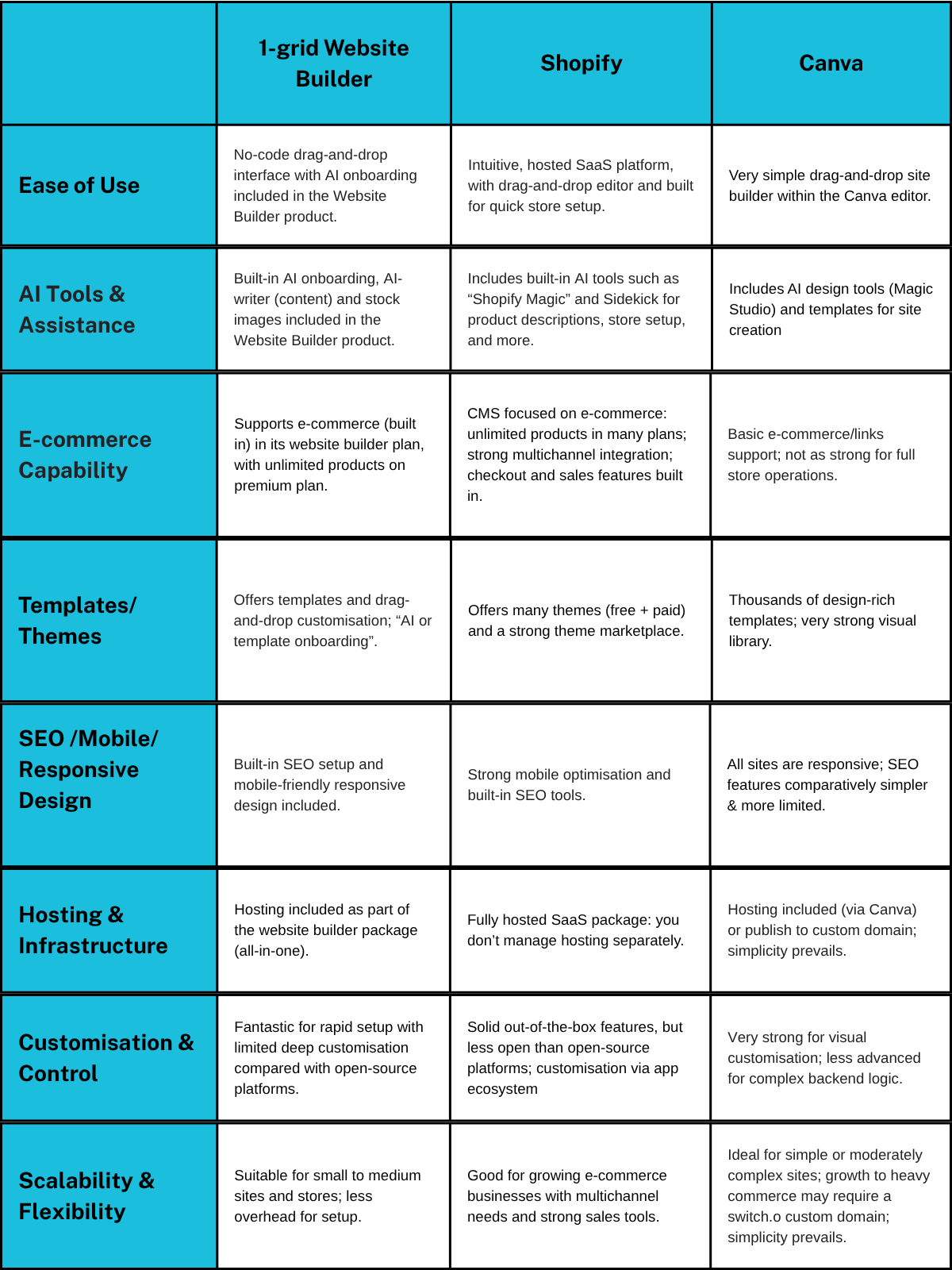
The table below compares key features of each website builder platform to better understand how they differ in areas such as ease of use, AI support, e-commerce capability, templates, SEO and mobile readiness, as well as other relevant factors.
Utilising AI to Build Your Website
With the rise of AI many are wondering whether AI platforms like ChatGPT can be used to build websites from scratch with a few prompts. The reality is that these AI platforms can assist with website creation by generating code snippets, layout suggestions, or written content, but it cannot build or host a complete website on its own.
While standalone AI tools can design pages or produce content, they lack integration with hosting, databases, and e-commerce systems, which limits their ability to deliver a fully functional, high-quality site. These tools may also struggle with responsive design, optimisation, and consistent branding unless used alongside a professional website builder.
AI-powered builders such as 1-grid’s Website Builder overcome these challenges by combining AI assistance with an all-in-one platform that includes hosting, templates, and e-commerce features. The AI helps users set up their site quickly, while the built-in infrastructure ensures professional performance and security. This makes 1-grid a better option for businesses seeking both convenience and quality, as it merges AI efficiency with the reliability of a dedicated website-building environment.
Pricing Breakdown for South Africa
The cost to build a website in South Africa can vary hugely depending on how it is built. If you use a DIY website builder, you might spend as little as R0-R500 for the first year (typically on a domain and hosting) as you use basic templates and minimal functionality.
On the other end, getting a custom-built professional website easily runs R3 000 to R50 000+ depending on complexity, bespoke design, integrations, and ongoing support.
A good middle ground for local small business is a platform like 1‑grid which offers affordable all-in-one pricing. Beyond the initial build you also have ongoing costs such as domains and website maintenance.
Below is a price breakdown by platform.
1-grid Website Builder
- Basic plan: runs for R129/month for 10 pages, AI onboarding, included hosting, free stock images and free trial booking addon.
- Standard plan: is R249/month and adds e-commerce (10 products) and up to 35 pages.
- Premium plan: will cost R349/month for unlimited pages and unlimited products.
Shopify
- Basic plan: is between R350-R450/month for the basic use case. This includes 10 inventory locations, 24/7 chat support and in-person selling by phone or POS device.
- Grow plan: costs around R980/month depending on the exchange rate, and allows for 5 staff accounts.
- Advanced plan: runs around R5800/month which increases staff accounts to 15 and adds local storefronts by market.
- Plus plan: will cost around R46 000/month on a 3 year term and include unlimited staff accounts, a fully customisable checkout, up to 200 POS pro locations, and B2B functionality.
On top of the monthly fee you have transaction fees when you use a third-party payment gateway since Shopify Payments is not supported locally. For the Basic plan, this extra fee is about 2.0% per sale and then decreases as the plan is upgraded.
Canva
Canva lets you build a website for free via its drag-and-drop tools and publish to a free Canva domain. To use your own domain or access premium features you may need to upgrade to Canva Pro which costs R110 per month or purchase a domain separately.
While the base cost can be extremely low, premium features or integrations might incur additional cost.
Pros and Cons: Which is Best for You?
Choosing the right website builder depends on your goals, budget, and level of technical skill. Some platforms are designed for speed and simplicity, while others offer complete creative control and scalability.
Below is a breakdown of the pros and cons of the leading website builders to help you decide which best fits your needs.
1-grid Website Builder
Best for South African small and medium-sized businesses looking for quick, AI-driven website creation with local support.
Pros
- Affordable local pricing: priced in Rand, with no foreign exchange fees, making it cost-effective for South African users.
- All-in-one solution: hosting, AI design tools, and e-commerce capabilities are included, removing the need for external plugins or add-ons.
- AI onboarding: streamlined setup using AI-generated content and design suggestions for a faster launch.
- Local support: dedicated South African support ensures quicker assistance and relevant guidance.
- Multilingual accessibility: available in 25 languages, making it suitable for businesses that serve diverse audiences.
- White-labelled technology: a globally trusted white-label site-building platform used by hosting companies worldwide, ensuring stability and professional-grade functionality.
- Outstanding security record: the 1-grid Website Builder has never been hacked, offering exceptional peace of mind and reliability for business owners.
Cons
- Limited advanced apps: compared to larger global platforms, 1-grid has fewer third-party app integrations.
- Smaller template library: offers fewer design options than open-source competitors.
Shopify
Ideal for businesses focused on selling products online and scaling their e-commerce operations.
Pros
- Robust sales tools: built-in inventory management and analytics.
- Scalability: handles everything from small shops to enterprise-level stores.
- Multi-channel selling: integrates with marketplaces and social platforms for expanded reach.
Cons
- Higher fees: monthly costs and transaction fees can add up, especially for small businesses.
- Less design flexibility: customisation options are more limited compared to open-source builders.
Canva
Best for visual-rich, simpler websites that emphasise design over heavy commerce.
Pros
- Ease of use: very low learning curve, drag-and-drop builder within Canva environment.
Strong design focus: huge template and visual asset library allows for elegant, brand-rich sites. - Free option: you can publish a basic website at no cost (with limitations).
Cons
- Limited e-commerce/cms depth: not as strong for full store operations, large blogs or complex backend logic.
- Fewer advanced integrations: blogging tools, SEO depth and complex database/commerce flows are more limited.
Tips for Choosing and Getting Started with a Website Builder
Selecting the right website builder begins with understanding your specific goals. If your main focus is online sales then platforms such as Shopify or 1-grid Website Builder are excellent choices, as they include built-in tools for product management, payments and checkout. For those who want to publish portfolios, showcase visual work, or run content-light business sites, Canva remains a very simple and visually-rich option.
It is also important to consider local elements such as hosting speed, payment options and pricing in South African Rand. A platform like 1-grid Website Builder stands out for local users because it includes fast South African hosting, transparent ZAR pricing and support that understands the local market.
Finally, keep your budget realistic. Most small businesses can build and maintain a professional site for under R5,000 per year, including domain registration and hosting.
Once you have chosen your platform, getting started is easier than ever. AI-driven website builders, such as 1-grid’s Website Builder, allow users to create professional websites in just minutes. The built-in AI onboarding helps you generate text, choose design layouts, and add images automatically. While AI is useful for content generation and ideas, it works best when combined with the structure of a dedicated builder to ensure functionality, mobile responsiveness, and security. After launch, continue refining your website by improving SEO and mobile optimisation to reach local audiences effectively.
To begin building your website with ease, visit 1-grid and explore our AI-powered Website Builder today.