
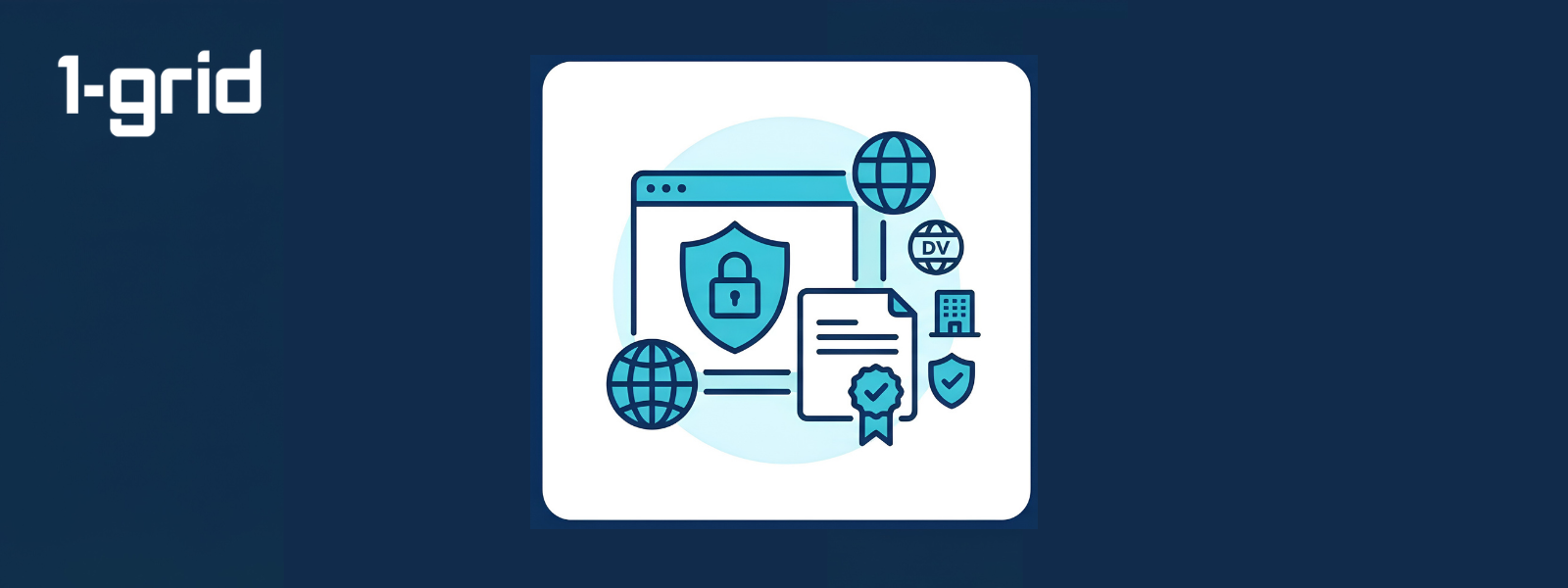
Choose the right SSL certificate for your website, protect your visitors’ information and understand when additional business verification may be needed.
Choosing an SSL certificate (such as DV vs EV SSL) doesn’t have to be complicated, and 1-grid makes it easy to get secure online. Whether you run a small business website, manage multiple subdomains or need to verify your organisation’s identity, the right certificate depends on what you need to protect and what your business requires.
At 1-grid, we offer Domain Validation (DV), Wildcard DV and Extended Validation (EV) SSL certificates. All provide encrypted connections, but the validation process and coverage differ.
This guide explains the differences, helps you identify which option may suit your website (such as DV vs EV SSL), and shows you where to explore our available SSL certificates.
Before You Begin
Before choosing an SSL certificate, it is important to consider these basic requirements:
- Website Coverage: Decide whether you need to secure one domain or multiple subdomains.
- Business Requirements: Check whether a client, payment provider or internal policy requires a particular validation level.
- Business Verification: Consider whether you need to verify domain ownership only or provide additional organisational information.
- Certificate Management: Be prepared to complete the required validation and manage certificate renewals or reissues.
TIP: You don’t necessarily need a higher validation level to get a secure connection. Start with what your website and business actually require, and this can help you establish a DV vs EV SSL.
What Is the Difference Between DV, OV and EV SSL?
The main difference between these certificate types is what the Certificate Authority verifies before issuing the certificate.
| Certificate Type | What It Verifies | Best Suited For |
|---|---|---|
| DV – Domain Validation | Confirms control of your domain name | Business websites, blogs and online stores |
| OV – Organisation Validation | Confirms domain control and verifies the registered organisation | Businesses requiring additional identity verification |
| EV – Extended Validation | Performs more extensive checks on the organisation’s legal identity and operational details | Businesses with specific organisational verification requirements |
Important: DV, OV and EV validation levels do not automatically provide different strengths of encryption. The distinction is the level of identity verification completed before the certificate is issued.
Domain Validation (DV)
DV confirms that you control the domain name for which the certificate is requested.
Validation is generally straightforward and can be completed through an approved method such as email, DNS or file verification.
Suitable for: Most standard business websites, blogs, brochure websites, and websites that need an encrypted connection.
Organisation Validation (OV)
OV goes beyond domain ownership by doing a check for the legal existence and registered details of the organisation.
The Certificate Authority may review business records and verify contact information before issuing the certificate.
Suitable for: Businesses that need to demonstrate their registered organisational identity.
Note: OV is not listed as a standard product in our current 1-grid SSL range. If your business specifically requires OV, contact our Team to discuss your requirements.
Extended Validation (EV)
EV involves more extensive verification of an organisation’s identity, legal existence and operational details.
The additional checks help establish that the organisation requesting the certificate is legitimate.
Suitable for: Businesses that have contractual, procurement or internal security requirements for extended organisational verification.
IMPORTANT: EV does not automatically provide stronger encryption, guarantee customer trust or prevent phishing. It provides additional organisational identity verification.
For a more detailed explanation of the validation process for a DV vs EV SSL, see our guide to Understanding SSL Validation Processes.
Which SSL Certificate Is Right for My Website?
Use the following guide to identify which of our available certificate types may suit your needs.
| Your Requirement | Certificate to Consider |
|---|---|
| Secure one business website or domain | DV SSL |
| Secure a main domain and its eligible subdomains | Wildcard DV SSL |
| Meet a requirement for extended organisational verification | EV SSL |
When Is DV SSL Enough?
For many small businesses and growing organisations, DV SSL is sufficient when the main requirement is to encrypt the connection between the website and its visitors.
Consider DV SSL if you:
- Run a company or brochure website.
- Manage a blog or information-based website.
- Have contact or enquiry forms.
- Need to secure a single domain.
If your website accepts payments, check your payment provider’s requirements before choosing a certificate.
When Should I Consider Wildcard DV SSL?
If your website uses multiple subdomains, a Wildcard DV certificate may be a suitable option.
For example, a Wildcard certificate for yourdomain.co.za can cover eligible subdomains such as:
shop.yourdomain.co.zamail.yourdomain.co.zaportal.yourdomain.co.za
This can simplify certificate management when you need to secure multiple subdomains under one domain.
When Should I Consider EV SSL?
Consider EV if your business specifically needs additional organisational identity verification.
This may apply where a business partner, contract, procurement process or internal security policy requires it.
TIP: Don’t choose a certificate simply because it has a higher validation level. Choose the one that meets your actual security, coverage, and business requirements.
What Happens After I Choose a Certificate?
Once you’ve identified the certificate that suits your requirements, you can explore and purchase the available options through our 1-grid SSL product page.
The general process is:
- Choose Your Certificate: Select the certificate and coverage that match your website requirements.
- Submit Your Details: Provide the information requested during the purchase and application process.
- Certificate Issuance: Once verification is complete, your certificate can then be issued, and installation can take place.
IMPORTANT: Validation requirements and processing times depend on the certificate type and Certificate Authority. Keep an eye on your email and respond to any verification requests promptly.
Remember, SSL certificates have shorter validity periods than before. You may need to complete validation and reissue your certificate more frequently, even if you have purchased a longer subscription.
Read our guide to Important SSL/TLS Certificate Lifecycle Changes and Why This Matters to understand what this means for your website.
You’re Ready!
You now have a clearer understanding of DV, OV and EV validation and the SSL options available through 1-grid.
For most websites, DV provides the required encrypted connection. If you manage multiple subdomains, Wildcard DV may be more suitable. If your business requires additional organisational identity verification, EV may be worth considering.
Explore your options and choose the right level of protection for your website.
Related Articles
- Understanding SSL Validation Processes
- Important SSL/TLS Certificate Lifecycle Changes and Why This Matters
- SSL Certificates and Why Do I Need One?
- Why Does My Website Say the SSL Certificate Is Untrusted?
- Why Doesn’t the Green Lock Show in the URL Bar?
Need Help?
If you’re unsure which SSL certificate is right for your website, our Team can help you understand the available options and the next steps.
Before contacting us, please have the following information ready:
- Your domain name.
- Your hosting package or service.
- The type of certificate you’re considering, if known.
- Any specific SSL requirements provided by your payment provider, business partner or organisation.
We’re here to help you make an informed choice and secure your website with confidence.